
The most expensive material mistake we see is not choosing the wrong sink. It is choosing the right sink in the wrong material for the household it is going into, and discovering that after installation.
We have helped 50,000+ customers choose kitchen and bath fixtures since 2018, and the same five mismatches show up on repeat:
- Ordering a fireclay farmhouse sink without confirming the cabinet size or whether the cabinet can carry the weight.
- Buying low-gauge stainless steel on price, then living with a basin that flexes and a sink that is loud.
- Paying composite prices for an acrylic sink, because the two materials were never compared.
- Choosing copper or natural stone, then wanting a finish that looks the same at year five as it did at install.
- Installing natural stone or NativeStone without committing to the resealing schedule it requires.
This guide names them so yours does not become one of them.
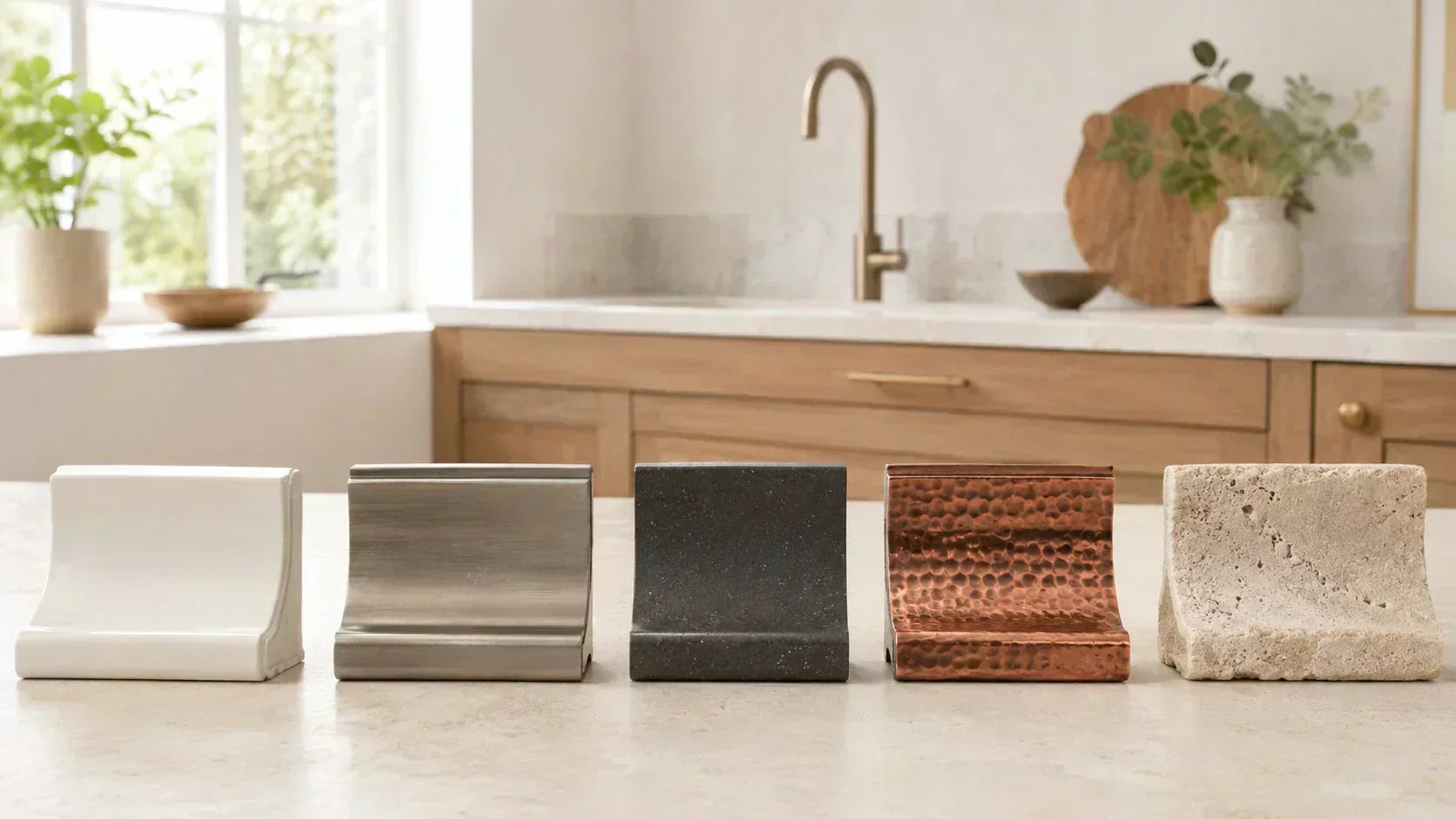
Below is a breakdown of every major kitchen sink material: what it is, how it performs in a real kitchen, who it is right for, and what to watch out for before you order.
Quick answer
For farmhouse and apron-front sinks, fireclay is the most durable and most commonly chosen material. For undermount and workstation kitchens, stainless steel and granite composite are the practical leaders. Copper, natural stone, and NativeStone concrete are specialty materials best suited for design-forward kitchens where the visual payoff justifies additional maintenance. The Sink Boutique is an authorized dealer of BOCCHI, Ruvati, Blanco, Native Trails, and more: all brands featured in this guide.
In this guide:
- Fireclay
- Stainless Steel
- Granite and Quartz Composite
- Copper
- Natural Stone
- NativeStone Concrete
- Cast Iron
- Material Comparison Table
- How to Choose
Fireclay
Fireclay is fired at temperatures above 2,000°F, which fuses the clay and glaze into a single non-porous surface. That firing process is what gives fireclay its chip resistance, stain resistance, and the glossy, consistent finish that makes it the default material for farmhouse and apron-front sinks. It is not immune to damage under severe impact, but it holds up to daily kitchen use better than most materials in this category.

The weight matters. A 33-inch fireclay farmhouse sink typically runs 70 to 100 pounds. Before ordering, confirm that your base cabinet and countertop support structure can handle that load. We catch sizing and support questions before anything ships, but it helps when buyers check their cabinet specs first.
Sizing note: Fireclay is handcrafted, and finished measurements can vary slightly from the nominal size. A sink listed at 33 inches may measure marginally over or under. When the fit is tight, that margin matters. Confirm your cabinet opening against the specific product's stated dimensions before you finalize the order.
Color finish is the other decision most buyers underestimate. White and matte white look different in natural vs. artificial light, and they look different next to warm-toned vs. cool-toned cabinetry. White and matte white read differently in natural versus artificial light, and differently next to warm-toned versus cool-toned cabinetry. We have sent color samples to buyers deciding between finishes. If you are weighing two finishes, ask us before you order
Fireclay pros: Non-porous surface resists stains and bacterial growth. Chip-resistant glaze holds up to daily use. Timeless appearance that works in traditional, transitional, and contemporary kitchens. Available in white, matte white, matte black, biscuit, and other finishes, depending on the brand.
Fireclay cons: Heavier than stainless steel and composite, requiring adequate cabinet support. More expensive than stainless steel at comparable sizes. Measurement tolerances require careful pre-purchase cabinet confirmation.
Care: Mild soap and a soft cloth for daily cleaning. A sink grid protects the basin floor from heavy pots. Touch-up kits are available for minor chips, though significant impact damage is rare with proper installation and use.
"I had questions before ordering... the company not only sent me the color I was questioning (matte white), but they also sent me glossy white and biscuit to compare... It is HEAVY!! It's the 36" wide Bocchi farmhouse fireclay sink. I can't wait to see it in my newly renovated kitchen."
— Susan Kiggins, verified customer
One thing to know before buying: The weight is not a con — it is structural proof of the material. But it does require proper cabinet support. Confirm your base cabinet is rated for the weight before ordering.

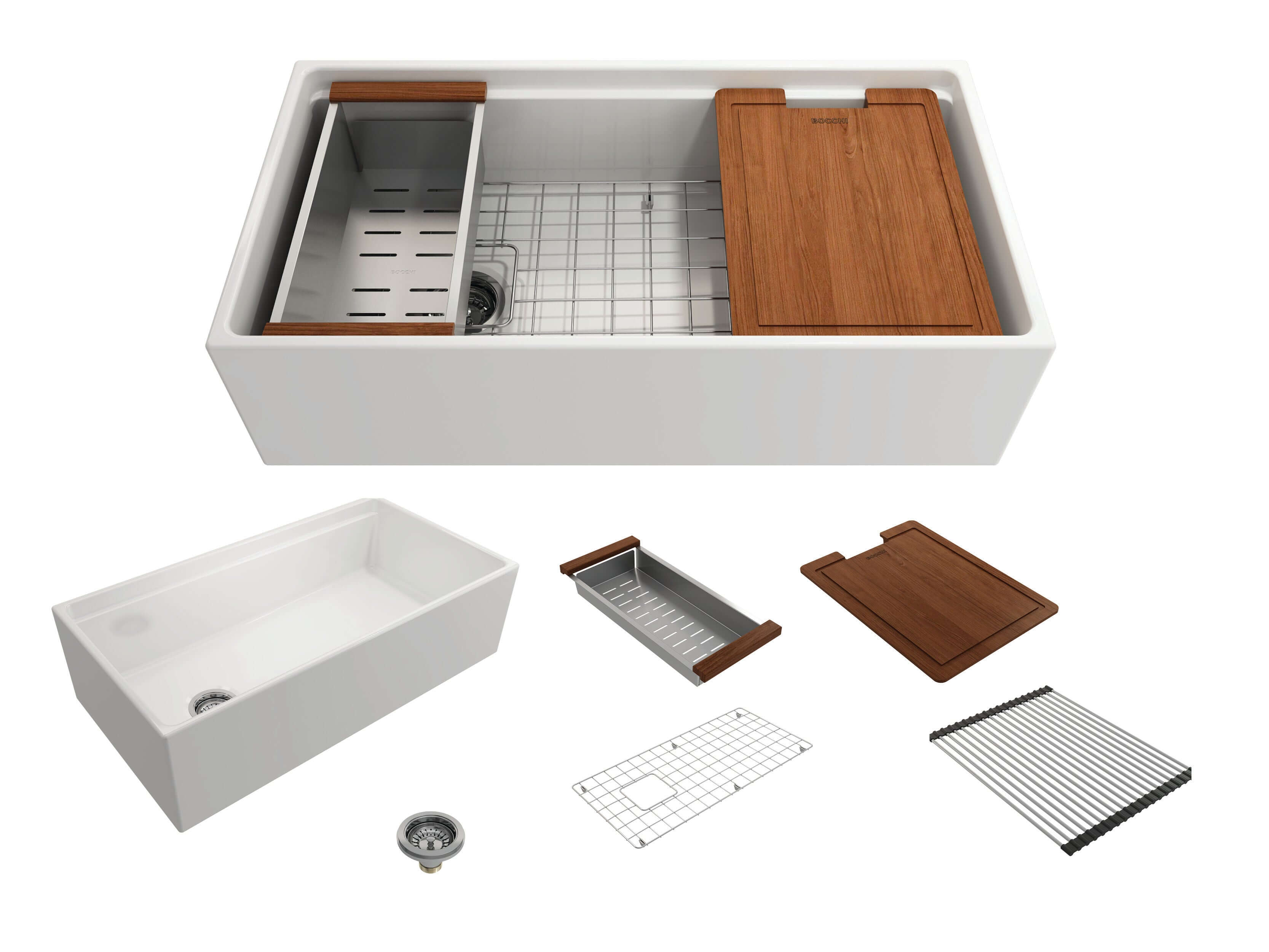
Browse the BOCCHI Contempo 33-inch fireclay farmhouse sink →
Browse the full fireclay farmhouse sink collection
Stainless Steel
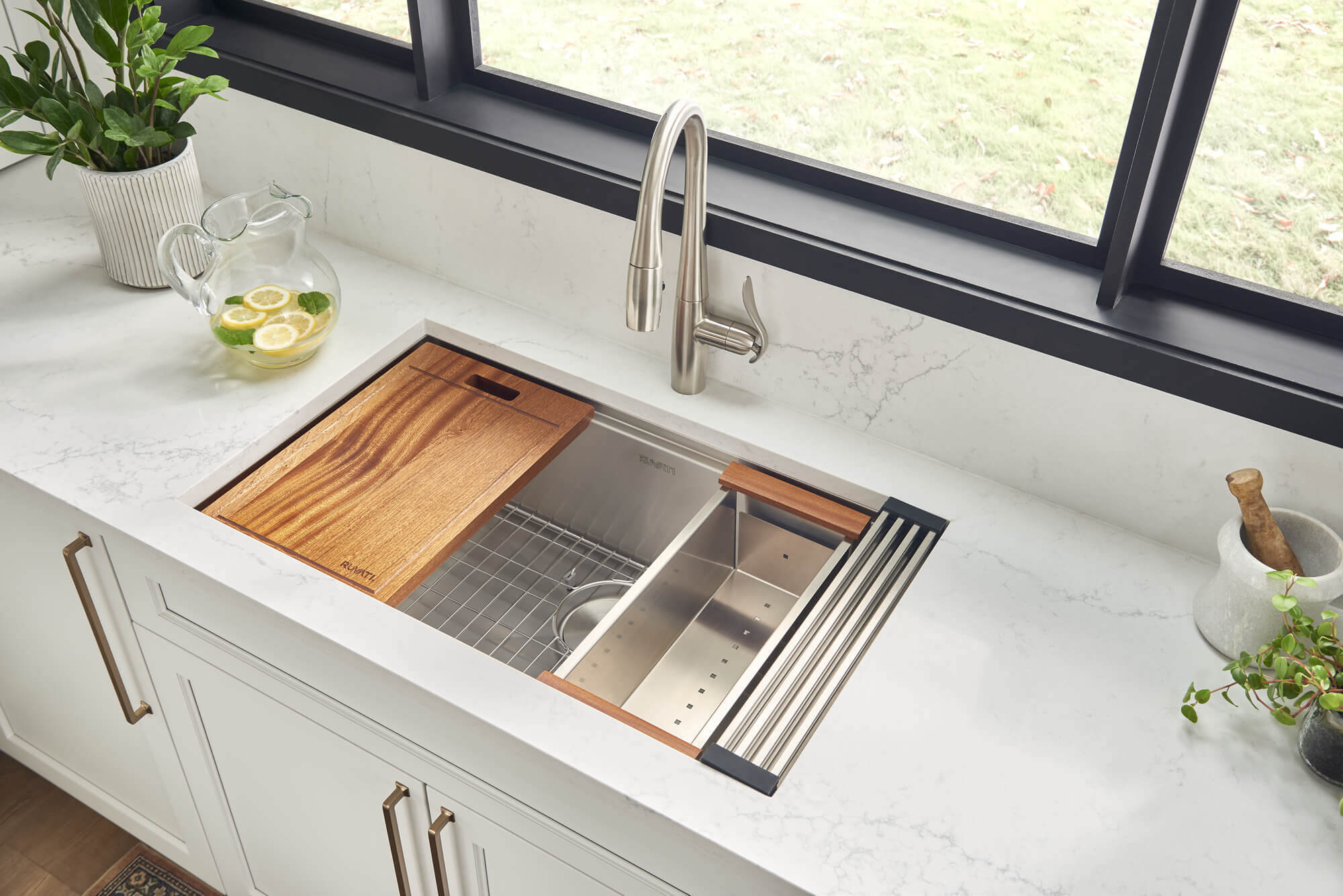
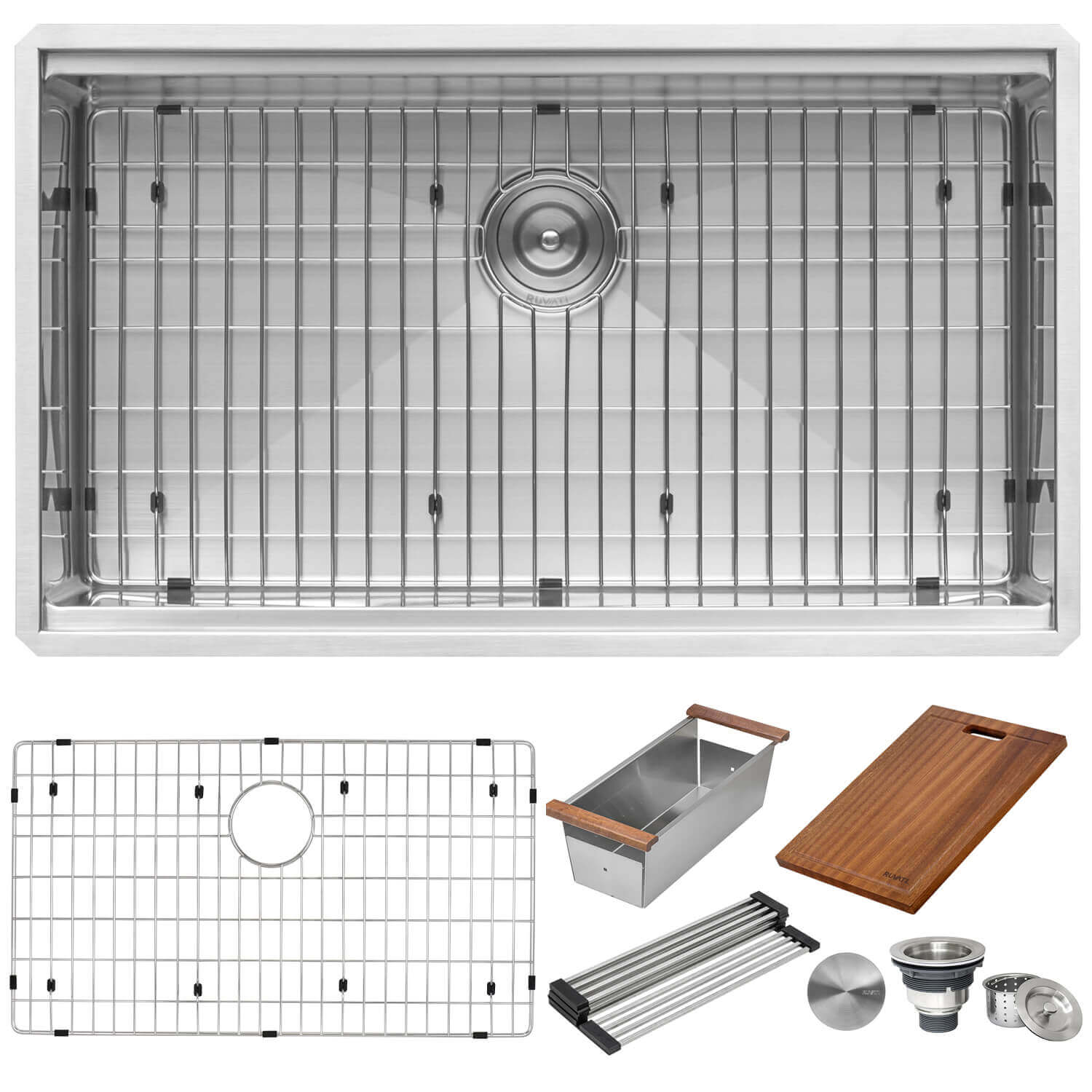
Stainless steel has been the kitchen standard for decades because it earns that position on every practical metric: it does not chip, it resists heat, it cleans easily, and it pairs with any countertop material or hardware finish. The workstation category has pushed stainless steel into a higher design tier as well, with the addition of integrated ledge systems, accessories, and multi-tier bowl configurations that make the sink a functional workspace rather than just a basin.

Gauge matters more than most buyers realize before they start shopping. A 16-gauge stainless steel sink has a steel thickness of 0.060 inches. A 20-gauge sink is thinner at 0.036 inches, which means more noise when water hits it, more deflection under heavy pots, and a shorter lifespan. We carry 16-gauge and 18-gauge stainless steel sinks as the standard; if a product does not list its gauge, that is worth asking before you order.
Expert note: The most common stainless steel regret we see is buying a 20-gauge or lower-grade sink because the price was lower, then noticing within the first year that the basin flexes under a full stockpot and the sound insulation is inadequate. Sixteen-gauge is the entry point for a sink that performs the way stainless steel is supposed to.
Stainless steel will scratch with heavy use. That is not a flaw in the material — it is a property of the finish. Brushed stainless steel develops a patina over time that makes light surface scratches less visible. Highly polished finishes show marks more readily. For a family kitchen with daily heavy use, a brushed or satin finish is the more forgiving choice.
Stainless steel pros: Resists chipping, cracking, and heat damage. Lighter than fireclay or stone, which simplifies installation. Available in single bowl, double bowl, undermount, drop-in, farmhouse, and workstation configurations. Compatible with any countertop material.
Stainless steel cons: Scratches and watermarks are visible with use, particularly on polished finishes. Lower-gauge versions are noticeably noisier. Does not carry the visual warmth of fireclay or copper in traditional or farmhouse kitchen designs.
Care: Wipe down with a soft cloth after use to prevent watermarks and mineral deposits. For scratches, a stainless steel cleaner applied in the direction of the grain can minimize their appearance over time.
One thing to know before buying: A workstation stainless sink includes accessories, but the accessories are only useful if the bowl is deep enough to use them at full function. Confirm the basin depth and the ledge height against your intended workflow before ordering.

Browse the Ruvati dual-tier 36-inch workstation sink, 16-gauge →
Browse the full stainless steel farmhouse sink collection
Granite and Quartz Composite
Granite and quartz composite sinks are made from natural stone particles (typically 80% quartz or granite, depending on the brand) bound in acrylic resin. The result is a material that is denser than stainless steel, more resistant to scratching and staining than many buyers expect, and available in a color range that includes matte black, anthracite, truffle, and white finishes that complement contemporary kitchen designs. Blanco's Silgranit is one of the most specified composite formulations available; it is the material used in the Blanco Ikon featured below.

Noise is genuinely better in composite than in stainless steel. The dense material absorbs sound from running water, garbage disposal, and dropped dishes in a way that a hollow stainless steel sink cannot match. Buyers who have lived with a lower-gauge stainless sink and found the sound objectionable often land on granite composite as the upgrade that addresses that problem specifically.
Granite and quartz composite pros: Scratch-resistant, chip-resistant, and stain-resistant surface. Significantly better sound absorption than stainless steel. Non-porous: does not harbor bacteria. Available in colors and matte finishes not available in fireclay or stainless at comparable price points.
Granite and quartz composite cons: Heavier than stainless steel, though lighter than fireclay. Higher price point than stainless steel at comparable configurations. White composite can show residue from hard water deposits without regular maintenance.
Care: Mild dish soap and water for daily cleaning. A non-abrasive cream cleaner for mineral deposits. Avoid bleach-based cleaners on composite; they can break down the resin over time.
"We replaced a stainless steel two-bowl sink with this single bowl granite composite and we love it. It's deep and wide, so plenty of work surface. This sink also dampens noise much better, so we barely hear our garbage disposal when we run it."
— Carol D., verified customer
One thing to know before buying: Composite and acrylic sinks are not the same material, and the price difference reflects that. Composite is stone-based and dense. Acrylic is plastic-based and much lighter. If a composite-style sink is priced well below comparables, confirm the actual material composition before ordering.

Browse the Blanco Ikon 33-inch granite composite farmhouse sink →
Browse the full granite composite kitchen sink collection
Copper
Copper sinks develop a patina. That is not a defect — it is the defining characteristic of the material, and it is worth being specific about what that means before you order. A new copper sink arrives with a relatively consistent reddish-gold or oil-rubbed finish depending on the style. Over weeks and months, the surface darkens and develops variations in tone where water contacts it regularly, lighter in the basin where it is rinsed frequently and darker around the edges where it is not. The result is a living finish that changes with use.

Buyers who want a sink that looks the same at year five as it did at install are better served by fireclay or composite. Buyers who find the evolving finish appealing — and many do, particularly in warm-toned or traditional kitchens — are choosing copper for the right reason.
Copper also has natural antimicrobial properties. Copper has long been valued for its natural material properties, including resistance to corrosion and rust. Copper is also widely used in settings where its surface characteristics are valued.
Copper pros: Unique, evolving finish that adds visual character over time. Natural antimicrobial surface. Resistant to rust and corrosion. Each sink is hand-hammered, meaning no two are identical.
Copper cons: Requires more active maintenance than any other material on this list if you want to influence how the patina develops. Acidic foods (citrus, vinegar) accelerate patina formation and can cause uneven darkening if not rinsed promptly. Higher cost than stainless steel or composite at comparable sizes.
Care: Rinse and dry after use to control patina development. Avoid leaving acidic foods or harsh cleaners on the surface. No abrasive scrubbers. If you want to restore shine to a specific area, a copper-specific cleaner works, but it will affect the patina pattern.
One thing to know before buying: The finish will change, and the rate of change is influenced by how you use the sink. If a perfectly consistent finish is important to you, copper is not the right material. If you want a sink that develops personality with use and age, copper delivers that in a way no other material does.

Browse the Premier Copper Products 33-inch copper farmhouse sink →
Browse the full copper farmhouse sink collection
Natural Stone
Every natural stone sink is cut from a single block of stone. That means the color, veining, texture, and character of your sink are determined by the specific piece of stone it was made from — no two are the same. Travertine, marble, granite, and limestone are the most common materials, each with a different density, porosity, and appearance. Travertine tends to have warm and earthy tones. Marble is white to gray with pronounced veining. Granite is the hardest and least porous of the common stone types. Limestone is softer and has a more uniform, understated appearance.

Porosity is the critical variable with natural stone. Unsealed or improperly sealed stone will absorb water, staining agents, and acidic liquids. A well-sealed stone sink is resistant to all of these, but the sealant is not permanent. Periodic resealing, typically every one to three years depending on use, is part of owning a stone sink. This is not an onerous task, but it is a commitment. Buyers who skip it will see staining over time that cannot be reversed without professional refinishing.
Important: Ask your stone sink manufacturer for the recommended sealing schedule before the sink is installed. Some stones require sealing before installation, some after, and some benefit from both. The installation moment is the easiest time to seal; it gets harder once the sink is set in the countertop.
Heat resistance is a genuine strength of natural stone. A hot pan placed directly in a stone sink will not warp or discolor the surface the way it might with a lower-quality composite or acrylic material. Stone also does not scratch from normal cutlery or cookware contact, though heavy impact from a cast iron pan can cause chipping in softer stones like travertine or limestone.
Natural stone pros: Unique piece cut from a single block. Excellent heat resistance. Hard, dense surface resists scratching from normal kitchen use. Long lifespan with proper care.
Natural stone cons: Requires sealing before first use and periodic resealing. Significantly heavier than any other material on this list, often requiring reinforced cabinet support. Higher cost. Susceptible to staining if sealing is neglected.
Care: Mild pH-neutral cleaner only. Never bleach, vinegar, or use citrus-based cleaners on stone. Reseal on the schedule recommended by the manufacturer, and immediately if water is no longer beading on the surface.
One thing to know before buying: The product image shows one specific piece of stone. The sink you receive will be a different piece from the same stone type, with its own color variation and veining pattern. That variation is the point of the material. If you need exact color consistency, stone is not the right material for your project.

Browse the Allstone 36-inch smoke brown limestone farmhouse sink →
Browse the full natural stone kitchen sink collection
NativeStone Concrete
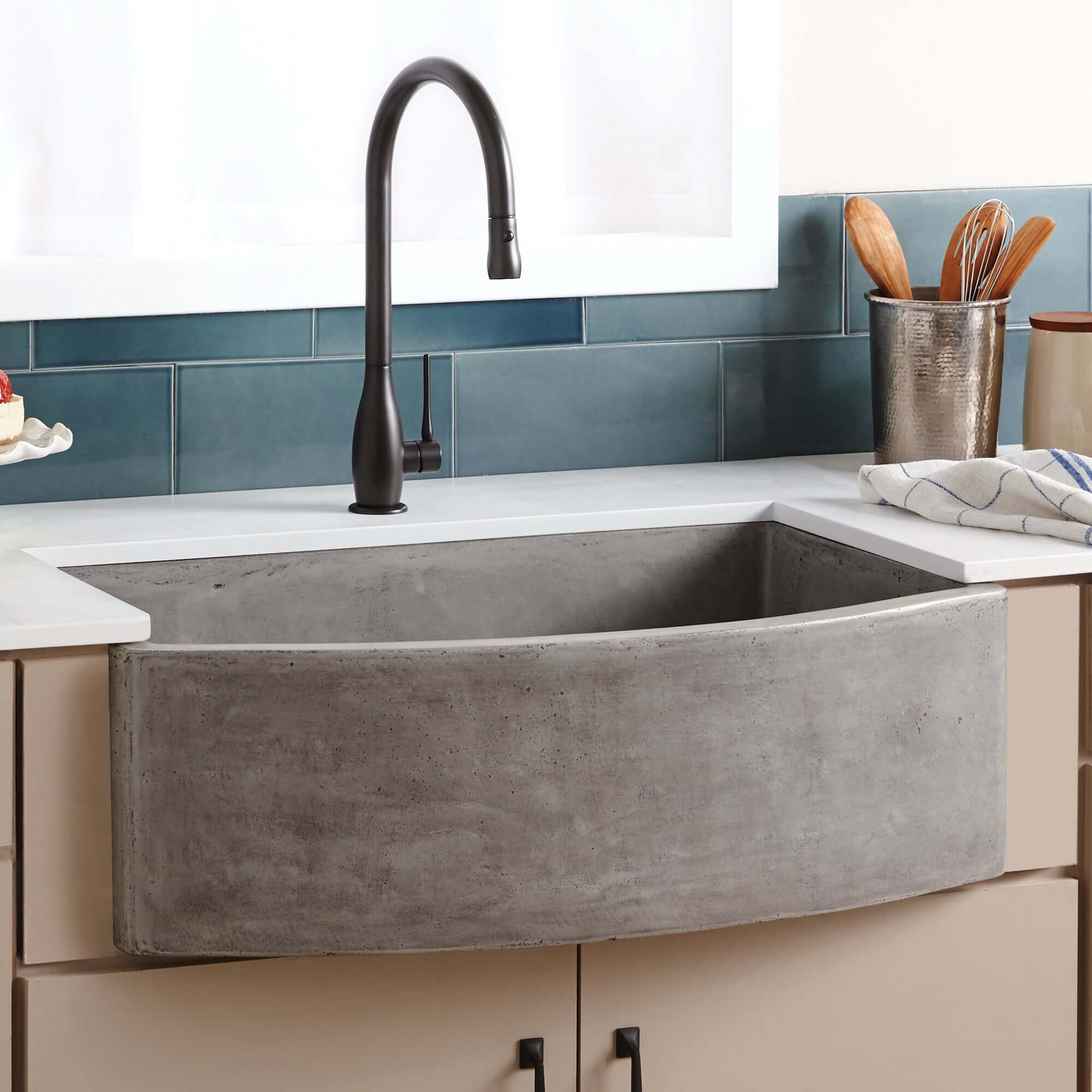
NativeStone is Native Trails' proprietary material: a composite of natural stone aggregate and other minerals, hand-cast in the United States. It is not poured concrete in the traditional sense, which means it does not carry the same installation complexity as custom poured-in-place concrete sinks, and it does not have the same micro-cracking risk that plagues cheaper concrete composites. The result is a sink with the visual warmth and texture of concrete, the practical durability of a manufactured composite, and a natural color variation that makes each piece distinct.

NativeStone sinks are available in a range of earthy finishes: ash, charcoal, slate, and similar tones that work particularly well in modern farmhouse, industrial, and design-forward kitchen projects. They carry the same sealing and maintenance requirements as natural stone: a periodic reseal keeps the surface protected, and pH-neutral cleaners are the daily standard.
The weight is comparable to natural stone, which means cabinet support assessment is required before ordering. The upside of the NativeStone construction vs. poured concrete is dimensional consistency: each sink is manufactured to specifications and will meet the stated measurements without the tolerance variation inherent in handmade poured concrete.
NativeStone pros: Distinctive earthy aesthetic not available in fireclay, stainless, or composite. More dimensionally consistent than poured concrete. Hand-cast in the United States. Available in farmhouse, undermount, and other configurations depending on the series.
NativeStone cons: Requires sealing before first use and periodic resealing, same as natural stone. Heavy, requiring confirmed cabinet support. Fewer finish options than fireclay or stainless steel. Higher cost than stainless steel or composite at comparable sizes.
Care: Seal before first use with a product recommended by Native Trails. pH-neutral cleaners only. Reseal annually or when water stops beading on the surface.
One thing to know before buying: NativeStone is a specialty material that tends to appeal to buyers who know exactly what aesthetic they are building toward. If you are still deciding between materials, spend time with fireclay and composite first. NativeStone rewards buyers who have already committed to the earthy, textured look it delivers.

Browse the Native Trails NativeStone 33-inch farmhouse sink, ash →
Browse the full Native Trails collection
Cast Iron
Cast iron sinks have a porcelain-enameled iron base. The iron core is extremely heavy, and the enamel coating provides the finished surface. Historically, cast iron was the default kitchen sink material before stainless steel became standard in the mid-20th century, and the deep, substantial feel of a cast iron basin still appeals to buyers who want that weight and depth in their kitchen.
The limitations are worth understanding before you shop. The enamel surface chips. A dropped cast-iron skillet or a hard impact from heavy cookware will chip the coating, and chipped enamel cannot be repaired to original condition. Cast iron sinks are also heavier than fireclay, stainless, and composite combined — some full-size models exceed 150 pounds — which creates real installation complexity, particularly for retrofit projects where the cabinet structure was not designed for that load. Color selection is also narrower than other materials: most cast iron sinks are available in white, biscuit, and a handful of additional colors, with limited availability in matte or contemporary finishes.
The Sink Boutique does not carry cast iron kitchen sinks. For buyers who want the depth and weight of cast iron in a daily driver, fireclay covers the same aesthetic territory with better chip resistance, a non-porous glaze, and better color availability at most price points. If cabinet modification for a heavy sink is part of your project plan, our guide to replacing a drop-in sink with a farmhouse sink covers the structural considerations in detail.
Browse fireclay farmhouse sinks, the modern alternative to cast iron
Material Comparison at a Glance
| Material | Durability | Scratch resistance | Heat tolerance | Maintenance | Weight |
|---|---|---|---|---|---|
| Fireclay Farmhouse choice | High | Good — chip-resistant glaze | High | Low | Heavy (70–100 lbs) |
| Stainless Steel | High | Fair — surface scratches with use | High | Low | Light to medium |
| Granite / Quartz Composite | Very high | Very good | High | Low | Medium to heavy |
| Copper | High | Good — patina conceals minor marks | Medium | Medium-high | Medium |
| Natural Stone | High when sealed | Good (varies by stone type) | Very high | Medium — requires resealing | Very heavy (100+ lbs) |
| NativeStone Concrete | High when sealed | Good | High | Medium — requires resealing | Heavy |
| Cast Iron | Good (if enamel intact) | Fair — enamel chips under impact | High | Low (if undamaged) | Very heavy (100–150+ lbs) |
Ready to order? Not sure which material fits your cabinet and countertop plan? Browse the farmhouse and apron-front sink collection or call us at (844) 470-1212, Monday through Friday, 9 AM to 5 PM EST. We confirm cabinet fit before anything ships.
How to Choose the Right Material for Your Kitchen
The right material depends on how the kitchen is actually used, not how it looks in product photos. Four scenarios cover most of what we see:

1. Heavy-use family kitchen with daily cooking, young children, or a lot of cast iron cookware.
Fireclay or granite composite. Both resist chipping and staining well under daily abuse. Granite composite has a slight edge on scratch resistance. Fireclay has a broader aesthetic range and is the standard for farmhouse apron-front applications. Stainless steel in 16-gauge is the third option if the budget is tighter — just expect visible scratches over time with that use pattern.
2. A careful adult household where the kitchen is used daily but not heavily.
Any material works here. The choice narrows to aesthetics and budget. Fireclay, composite, and copper are all practical for a household without heavy cookware impact or high-acid food prep. Copper is the most distinctive option for buyers who are drawn to its evolving finish and are willing to rinse and dry it consistently.
3. A designer or forever-home renovation where the sink is a feature of the room.
Natural stone, NativeStone concrete, or copper. All three deliver visual character that fireclay and stainless steel cannot replicate. All three require more maintenance commitment. The trade-off is worth it for buyers building a kitchen they intend to keep for 20+ years and want a focal material, not a background one.
4. A rental property or a flip where durability and cost efficiency matter most.
Stainless steel in 16-gauge or 18-gauge, single bowl or double bowl. It is the easiest to install, the easiest to clean, and the most durable under inconsistent use. For farmhouse-style flips, a 16-gauge stainless apron-front is a practical choice that photographs well without requiring specialty installation or maintenance instruction for future occupants.
Need a recommendation specific to your cabinet dimensions? If fireclay is the right call for your kitchen, the BOCCHI Contempo 33-inch is where most buyers start. Call us at (844) 470-1212 if you want to confirm the fit before ordering.
"The sink is so well-made compared to local big box store models. You get what you pay for."
— Cheryl Miner, verified customer
The Bottom Line
For most farmhouse and apron-front kitchens, fireclay is the answer. It has the best combination of durability, aesthetics, color availability, and ease of care for a permanent kitchen fixture. For workstation and undermount kitchens where function is the priority, stainless steel in 16-gauge and granite composite are both strong choices with different trade-offs on sound, scratch visibility, and finish options. Copper, natural stone, and NativeStone concrete are the right choice when the sink is designed to be a visual feature of the room, and the buyer has committed to the maintenance those materials require.
Where things go wrong is not usually in the material choice itself — it is in the purchase. A buyer orders a fireclay farmhouse sink from a marketplace listing, it arrives without manufacturer documentation, the installation reveals a defect, the buyer contacts the manufacturer for warranty support, and the manufacturer confirms the product was not purchased through an authorized dealer. At that point, the warranty claim is declined. The buyer either pays out of pocket for a replacement or reinstalls the defective unit. We have seen this sequence enough times to say it plainly: buying from an authorized dealer is not a marketing claim. It is what keeps the manufacturer relationship intact, so warranty eligibility is not voided by the source of the purchase.
The Sink Boutique has been an authorized dealer of BOCCHI, Ruvati, Blanco, Native Trails, Premier Copper Products, Allstone Group, and more since 2018. Products purchased from The Sink Boutique are sold through authorized dealer relationships, which helps protect warranty eligibility and brand accountability. Manufacturer warranty terms vary by brand and product. For warranty terms on a specific product, see the product page or contact the manufacturer directly.
The Sink Boutique also donates a portion of net profits to environmental charities, because we believe the homes we help build should leave the world a little better than they found it. It is not something we lead with, but it is part of how this business operates.

The Sink Boutique is rated 4.88 stars across 1,628 verified customer reviews.
Phone: (844) 470-1212 | Monday through Friday, 9 AM to 5 PM EST
30-day return policy on unused, uninstalled items in original packaging | Read 1,628 verified reviews
Browse by material: fireclay farmhouse sinks | stainless steel farmhouse sinks | granite composite sinks | copper farmhouse sinks | natural stone sinks | NativeStone concrete sinks
Check out our infographic below >>>
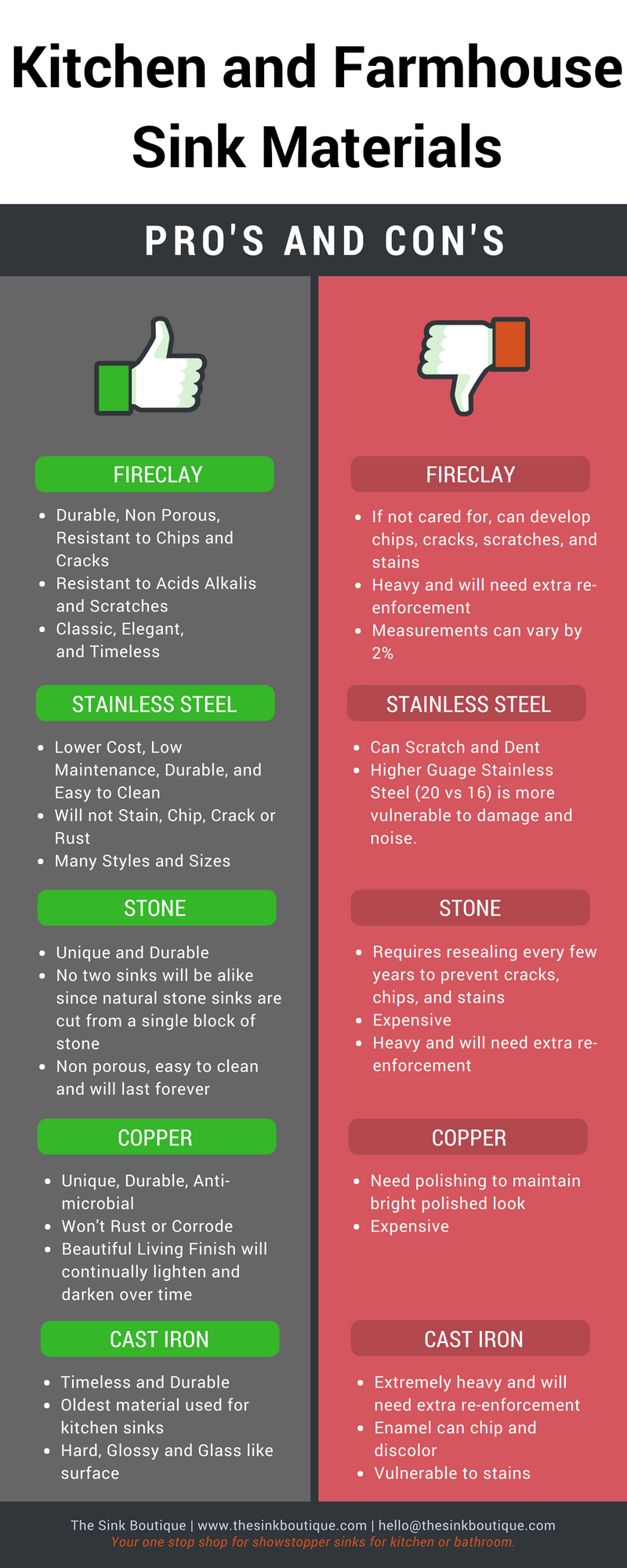
Have you decided on a kitchen sink? Share your thoughts and comments on the sink material you chose and why. We would love to hear from you.
If you enjoyed this post, pin it!




5 comments
Elaina D'Agostino
I loved how you said copper has natural anti-bacterial qualities, so it is a perfect choice for kitchen and bathroom sinks. If so, then my mom would love to have a copper sink in her kitchen. After all, she’s all about safety and sanitation, especially because of the pandemic. https://newpipeplumbingfl.com/sink-installation
Tap and Sink Contemporary Living
Informative piece on the the various pros and cons of kitchen & farmhouse sinks.. Good read!
Kr_Rego
So glad I found your website. You have a wonderful selection of sinks.
Scotty K
I was really concerned about getting the right sink material for my kitchen redesign. Although fireclay is not like stainless steel, we decided to go with it for it’s look and apron front design. This article really helped us. Thanks for putting it together.
Sheryl C
Thanks for this post. It has really helped me narrow down on the sink selection for my kitchen remodel.