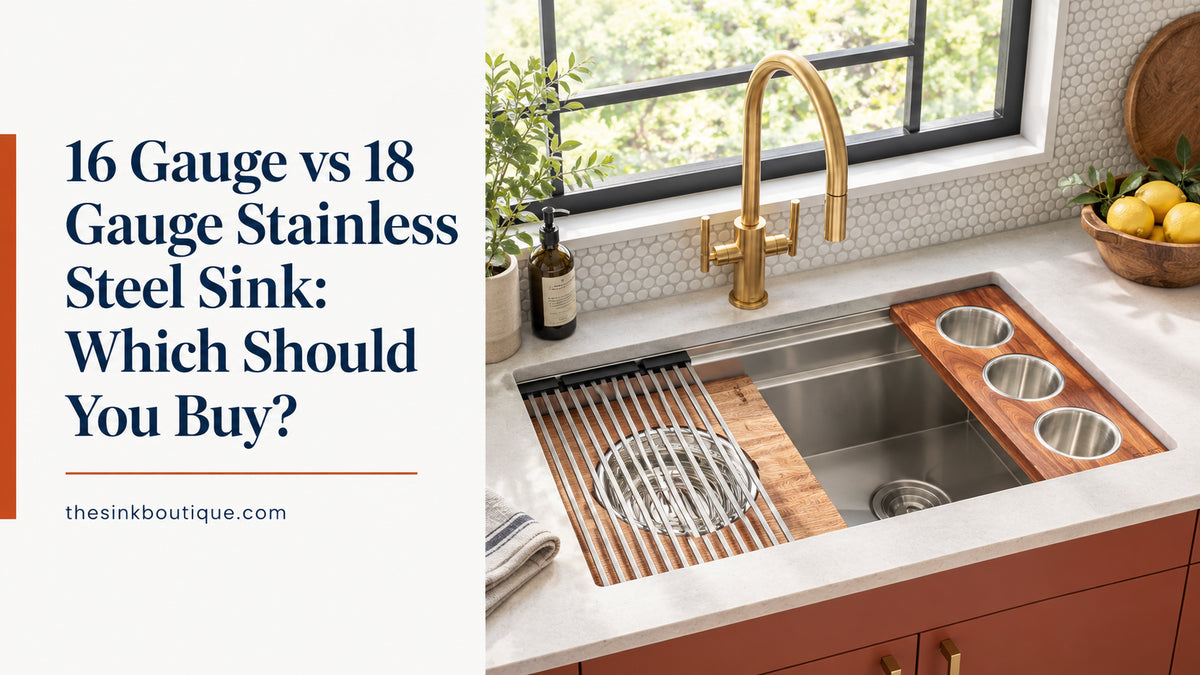
Two stainless sinks can look identical on screen, and one costs more because the spec sheet says 16 gauge instead of 18. Across 50,000+ orders since 2018, it is one of the questions our team at The Sink Boutique answers most.
Quick answer
A 16 gauge stainless sink is 0.0625 inches thick; 18 gauge is 0.050 inches, so 16 gauge is 25% thicker. Choose 16 gauge for a main sink 30 inches or wider that handles heavy pots. A well-made 18 gauge 304 sink with sound pads suits prep, bar, and lighter-use sinks. Our rule as an authorized dealer since 2018.
The choice deserves a clear answer. In the 2026 U.S. Houzz Kitchen Trends Study, 85% of renovating homeowners upgraded their sink, and only countertops were replaced more often. Once an undermount sink is set beneath stone, it stays, so the gauge you pick now is the one you live with. For brands, finishes, and configurations beyond gauge, start with our stainless steel kitchen sink buying guide.
In this article:
What sink gauge means
16 gauge sinks and our picks
18 gauge sinks and our pick
Side-by-side comparison
What matters more than gauge
How to choose
The bottom line
What does stainless steel sink gauge mean?
Gauge is a thickness scale that runs backward: the lower the number, the thicker the steel. A 16 gauge sink is formed from heavier sheet than an 18 gauge sink, and both are thicker than the 20 and 22 gauge steel used on entry-level sinks.
Stainless sheet has its own gauge chart. On it, 16 gauge measures 0.0625 inches (1.59 mm) and 18 gauge measures 0.050 inches (1.27 mm). The gap is 0.0125 inches, about the thickness of three sheets of printer paper, and it gives a 16 gauge sink roughly 25% more steel in every square foot.
Expert note: If you have seen 16 gauge listed as 0.0598 inches and 18 gauge as 0.0478, those figures come from the gauge chart for carbon steel, not stainless. Many sink pages mix the two charts, which is why thickness claims online rarely match. For stainless steel sinks, 0.0625 and 0.050 inches are the correct figures.
Gauge only compares stainless to stainless. To see how stainless stacks up against fireclay, granite composite, and copper, read our kitchen sink materials comparison or our breakdown of fireclay vs. stainless steel sinks.
16 gauge stainless steel sinks: where the extra thickness pays off
Thicker steel resists dents and flexes less under load. That matters most in three places: a wide basin with a long, unsupported floor, an undermount sink hanging from clips beneath a stone countertop, and a workstation sink carrying cutting boards and colanders on its ledge. If you cook with cast iron or fill a large stockpot in the sink every week, 16 gauge is the safer spec.
Top pick: 16 gauge
Ruvati Dual-Tier 33-inch Undermount Workstation Sink, 16 Gauge (RVH8222)
| Price | $649 |
| Gauge and steel | 16 gauge, T-304 (18/10) stainless |
| Size | 33.5" wide x 19" front to back |
| Bowl depth | 10" with a 1" slope to the drain |
| Cabinet needed | 36" minimum |
| Installation | Undermount |
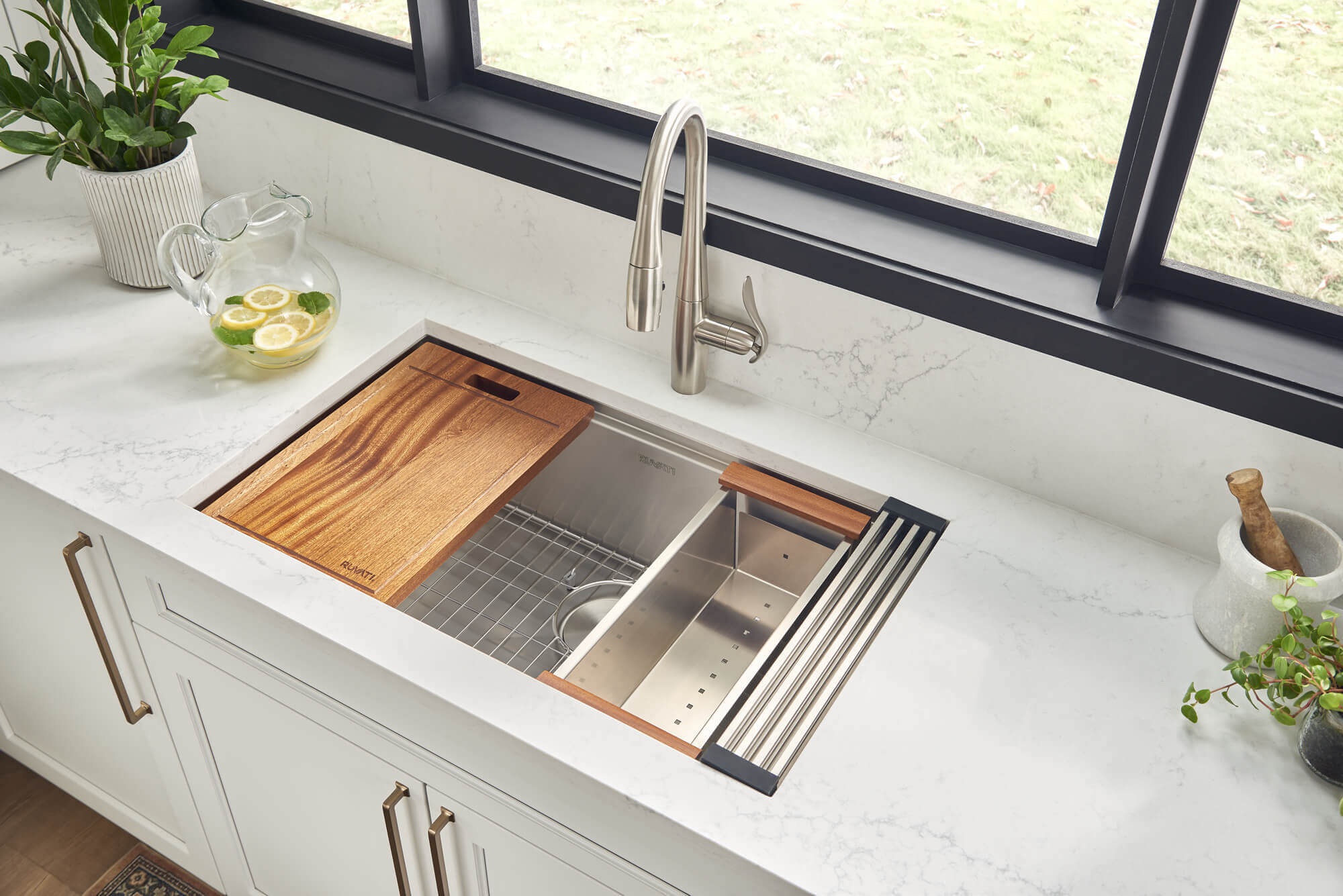
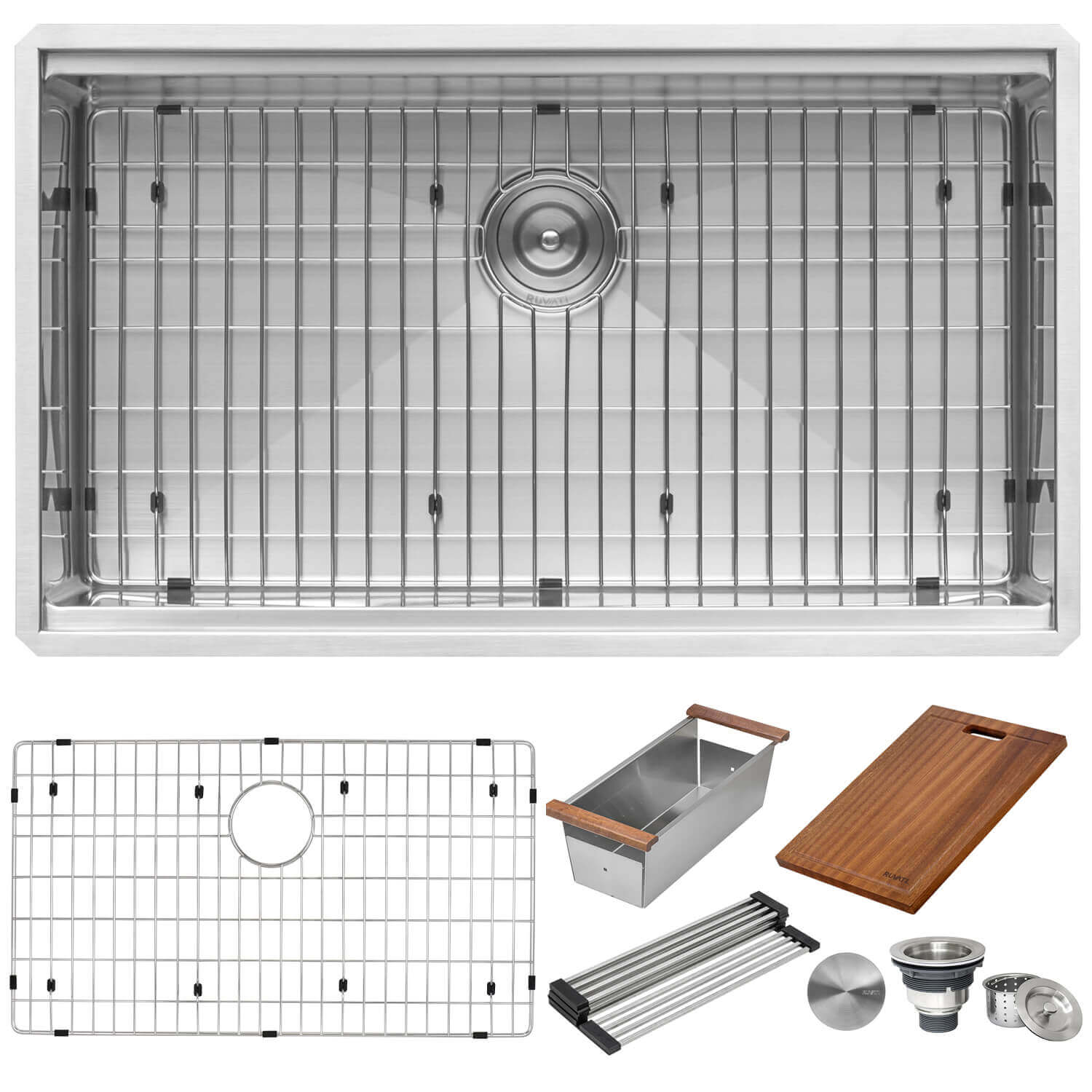
This is the sink we point most main-kitchen buyers to once they have settled on 16 gauge. It pairs T-304 stainless with sound pads on the sides and bottom, and the bowl floor slopes toward an offset drain so water does not sit in the corners. The two-tier ledge holds a cutting board, colander, mixing bowls, and a drying rack, which is exactly the kind of daily load where thicker steel earns its cost. Ruvati backs it with a limited lifetime warranty.
"What a lovely sink. Extremely well-made and insulated."
Lisa P., verified customer
One thing to know before buying: This 33-inch sink needs a 36-inch base cabinet. The mounting hardware takes about 1.5 inches on each side, so measure the inside of your cabinet, not the old sink, before you order.

Buy the Ruvati Dual-Tier 33-inch, 16 gauge →
Comparing Ruvati models? Our Ruvati sinks buyer's guide walks through the full workstation lineup.
Best value in 16 gauge
Nantucket Sinks Sconset 32-inch Undermount, 16 Gauge (MOBYXL-16)
| Price | $442.49 |
| Gauge and steel | 16 gauge, 304 stainless |
| Size | 31.5" wide x 20.5" front to back |
| Bowl depth | 9" |
| Cabinet needed | 33" minimum |
| Installation | Undermount, solid surface countertops only |
The Sconset 32-inch shows that 16 gauge does not have to be expensive. Its oblong shape gives you a wide washing zone on the left and a narrower rinse zone on the right, all in one bowl with no divider. The sloped floor drains completely, the brushed satin finish hides fine scratches, and a bottom grid and colander drain ship in the box.
"Stainless steel is durable and well-made, but it's louder than expected when dishes hit the bottom. Still, cleans easily."
Penelope E., verified customer
One thing to know before buying: Thicker steel does not make a sink silent. Dishes dropped onto the floor of any stainless sink still make noise, so keep the included bottom grid in place. Undermount installation also requires quartz, granite, or another solid surface; laminate will not work.

Buy the Nantucket Sinks Sconset 32-inch, 16 gauge →
18 gauge stainless steel sinks: when thinner is the smart buy
18 gauge is not a budget shortcut by default. Some of the most established stainless lines in the industry are built in 18 gauge 304 steel, and a well-made 18 gauge sink with full sound pads will outlast a poorly made 16 gauge one.
Where 18 gauge makes the most sense is a smaller basin: a prep sink, bar sink, laundry sink, or a compact main sink in a galley kitchen. A short bowl has a short span, so the steel flexes less to begin with. Under about 25 inches wide, the real-world gap between 16 and 18 gauge shrinks a great deal.
Premium 18 gauge
Elkay Lustertone Classic 17-inch Undermount, 18 Gauge (ELUH1418PD)
| Price | $679.99 |
| Gauge and steel | 18 gauge, Type 304 stainless |
| Size | 16.5" wide x 20.5" front to back |
| Bowl depth | 7 7/8" |
| Cabinet needed | 21" minimum |
| Installation | Undermount |
Elkay builds its Lustertone Classic line in 18 gauge, and it is priced as a premium product. This 17-inch undermount costs more than the 32-inch, 16 gauge Nantucket above, which tells you most of what you need to know: gauge alone does not set price or quality. You are paying for the Lustertone finish, which blends light scratches into the grain over time, and Elkay's Perfect Drain, which removes the gap around the drain opening where grime collects.
One thing to know before buying: At 7 7/8 inches, the bowl is shallower than most main kitchen sinks. It is built for prep and secondary duty, so pair it with a deeper primary sink rather than using it as your only basin.

Buy the Elkay Lustertone Classic 17-inch, 18 gauge →
Planning an island or prep station? Our bar and prep sink buying guide covers sizing and cabinet fit for secondary sinks.
16 gauge vs 18 gauge stainless steel sinks side by side
| Gauge | Thickness | Steel weight | Dent and flex resistance | Best for |
|---|---|---|---|---|
| 16 gauge Top pick | 0.0625" (1.59 mm) | About 2.5 lb per sq ft | Higher; most noticeable on wide undermount and workstation sinks | Main sinks 30" and wider, heavy cookware, workstation ledges |
| 18 gauge | 0.050" (1.27 mm) | About 2.0 lb per sq ft | Good; plenty for smaller basins | Prep, bar, laundry, and compact main sinks |
Noise is left out of the table on purpose. It depends more on sound pads than on gauge, which the next section explains.
Ready to order? Every listing in our stainless collection shows gauge and steel grade, so you can filter straight to what you need. Browse stainless steel kitchen sinks or call (844) 470-1212, Monday through Friday, 9 AM to 5 PM EST.
What matters more than gauge on a stainless steel sink
Gauge is the easiest spec to compare, so it gets more attention than it deserves. Steel grade, sound padding, and fabrication decide how a stainless sink performs over ten years.
Steel grade and fabrication. Look for Type 304 stainless, often listed as 18/10 for its chromium and nickel content. Weld quality, corner finishing, and how evenly the bowl is drawn also matter, and none of it shows up in the gauge number.
Important: The mistake we see most often is choosing a sink on gauge alone. A shopper finds an unbranded "16 gauge" sink for less than a name-brand 18 gauge model and assumes it is the better deal. It arrives with no listed steel grade, thin sound pads, and no clear manufacturer warranty. If a listing does not state Type 304 steel, the gauge number on it tells you very little.
Sound pads. When Consumer Reports tested stainless sinks, rubber pads on the outside of the basin cut noise more than spray coating or thicker steel did, as reported by Houzz. Check that pads cover the sides as well as the bottom.
Price gap within one brand. When the same sink is sold in both gauges, the upgrade is often small. We carried the Rene 28-inch undermount in both versions, with identical dimensions:
That is a $10 difference for 25% more steel. When the gap is that small, take the thicker sink. When two sinks differ by hundreds of dollars, you are usually paying for brand, finish, and accessories, not gauge.
How to choose between a 16 and 18 gauge sink
1. How wide is the sink?
If it is your main sink and 30 inches or wider, choose 16 gauge. Under about 25 inches, a well-made 18 gauge sink performs almost the same, and you can put the difference toward a better brand or finish.
2. What will you put in it?
Cast iron, heavy stockpots, and canning pots favor 16 gauge, especially in a single large bowl. If your sink mostly sees plates, glasses, and produce, 18 gauge is plenty.
3. Is it undermount, drop-in, or a workstation sink?
An undermount sink hangs from clips beneath the countertop, and a workstation sink adds the weight of boards and racks on its ledge, so both benefit from stiffer 16 gauge steel. A drop-in sink rests its rim on the counter, which gives 18 gauge more support. Most workstation sinks we carry are 16 gauge already, so that choice is usually made for you.
4. Does the listing state the steel grade?
If it does not, keep looking. Every sink in this article lists Type 304 stainless on its product page, and that line matters more than the gauge beside it.
5. How big is the price gap?
Compare the same sink from the same brand in both gauges whenever you can. A small gap is an easy call for 16 gauge, and a large one usually reflects features other than steel thickness.
Ready to order? If 16 gauge is the right call for your main sink, the Ruvati Dual-Tier 33-inch in 16 gauge is where most of our customers start, and for a prep station the Elkay Lustertone Classic 17-inch is the 18 gauge sink we would choose. Questions first? Call (844) 470-1212, Monday through Friday, 9 AM to 5 PM EST.
The bottom line on 16 vs 18 gauge stainless steel sinks
Choose 16 gauge for a main kitchen sink 30 inches or wider, and choose a well-made 18 gauge 304 sink for prep, bar, and compact spaces. In both cases, steel grade, sound pads, and the brand behind the warranty matter as much as the gauge number.
Authorized dealer note: Here is how a cheaper listing goes wrong. You buy from an unauthorized marketplace seller, your fabricator cuts the quartz to that sink, and months later a seam starts to discolor. When you file a claim, the manufacturer asks for proof of purchase from an authorized dealer, and without it many manufacturers decline coverage. Replacing an undermount sink at that point means working it out from beneath the stone and paying for the labor twice.
The Sink Boutique also donates a portion of net profits to environmental charities, because we believe the homes we help build should leave the world a little better than they found it. It is not something we lead with, but it is part of how this business operates.
Every sink in this article ships from The Sink Boutique with the full manufacturer warranty, and damaged or incorrect items are replaced free of charge. Shop stainless steel kitchen sinks, run your measurements through our kitchen sink fit check, or call (844) 470-1212 and we will confirm your cabinet width and installation type before anything ships.
The Sink Boutique is rated 4.88 stars across 1,628 customer reviews.
Phone: (844) 470-1212 | Monday through Friday, 9 AM to 5 PM EST